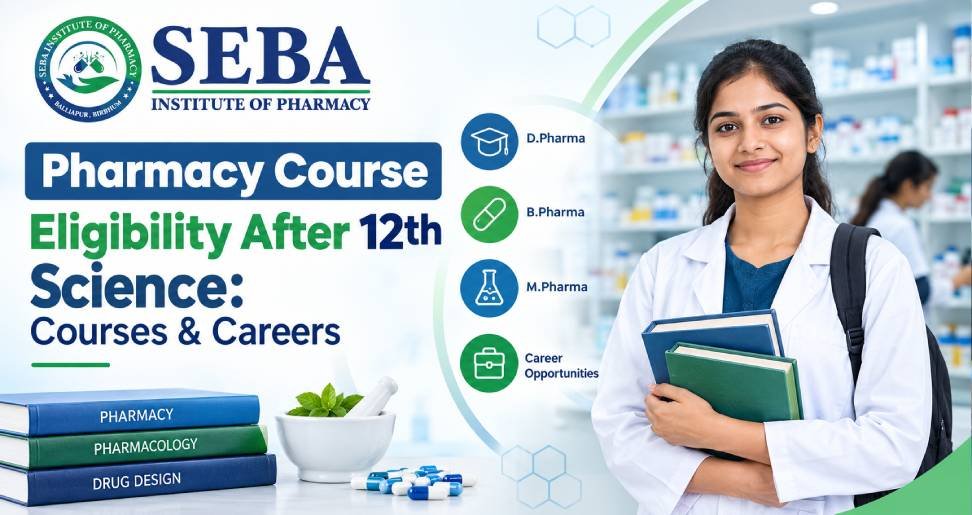
Choosing a career after Class 12 Science can be challenging, especially when students have multiple options in healthcare and life sciences. Pharmacy is one such career-oriented field that combines pharmaceutical science, chemistry, biology, healthcare, and patient care. Students who are interested in medicines, drug development, healthcare services, and the pharmaceutical industry can consider pharmacy courses after completing their higher secondary education.
If you are searching for pharmacy course eligibility after 12th Science, it is important to understand the basic academic requirements, available courses, duration, admission process, and future career opportunities. This guide explains the major pharmacy options available to Science students and also highlights how an institution such as Seba Pharmacy can support students in beginning their pharmacy education journey.
What Is Pharmacy?
Pharmacy is a healthcare and pharmaceutical discipline concerned with medicines and their safe and effective use. Pharmacy education introduces students to areas such as pharmaceutical chemistry, pharmacology, pharmaceutics, drug analysis, microbiology, medicinal chemistry, and clinical aspects of medicines.
A pharmacy professional can work in different environments, including community pharmacies, hospitals, pharmaceutical companies, laboratories, research organizations, quality-control departments, and healthcare institutions.
The field therefore offers opportunities for students who want to build careers connected with both healthcare and the pharmaceutical industry.
Pharmacy Course Eligibility After 12th Science
Students who have completed Class 12 in the Science stream can apply for different pharmacy programmes, depending on the course they choose.
According to the Pharmacy Council of India (PCI), approved pharmacy programmes such as D.Pharm, B.Pharm, and Pharm.D have admission requirements based on the 10+2 Science academic stream. PCI documentation specifies Physics and Chemistry along with Mathematics or Biology as relevant subjects for these programmes.
Students should also check the admission rules of the particular institution and the applicable state or university requirements before applying.
Basic Eligibility
Generally, students seeking admission to pharmacy courses after 12th should have:
- Passed Class 12 or an equivalent examination.
- Studied Science subjects at the higher-secondary level.
- Studied Physics and Chemistry along with Mathematics or Biology, depending on the programme and applicable regulations.
- Fulfilled the minimum marks and other admission requirements prescribed by the institution or relevant authority.
- Completed the required admission or counselling process wherever applicable.
The exact admission conditions can vary according to the course, institution, university, and applicable regulations.
Popular Pharmacy Courses After 12th Science
Students can choose from several pharmacy programmes depending on their career plans.
1. Diploma in Pharmacy (D.Pharm)
D.Pharm is a diploma-level pharmacy programme designed for students who want to enter the pharmacy profession through a relatively shorter course.
PCI identifies D.Pharm as a two-year programme, with admission based on the 10+2 Science academic stream with Physics, Chemistry, Mathematics or Biology.
The course generally introduces students to pharmaceutical sciences, medicines, dispensing, pharmacology, pharmaceutical chemistry, and practical aspects of pharmacy.
D.Pharm can be considered by students who want to develop foundational pharmacy knowledge and pursue opportunities in pharmacy-related settings, subject to the applicable registration and regulatory requirements.
2. Bachelor of Pharmacy (B.Pharm)
B.Pharm is a four-year undergraduate degree programme and is one of the most popular choices for students interested in building a long-term career in pharmacy.
The PCI’s B.Pharm regulations specify 10+2 with English and Physics, Chemistry and Mathematics and/or Biology as the relevant qualifying subjects. The programme extends over eight semesters, or four academic years.
During B.Pharm, students study subjects related to:
- Pharmaceutics
- Pharmaceutical Chemistry
- Pharmacology
- Pharmacognosy
- Biochemistry
- Microbiology
- Medicinal Chemistry
- Pharmaceutical Analysis
- Industrial Pharmacy
The combination of classroom learning and practical education helps students understand both the scientific and practical aspects of medicines.
3. Pharm.D
Another option after 12th Science is Pharm.D, a professional pharmacy programme with a longer duration.
PCI describes Pharm.D as a six-year professional programme after 10+2 Science, comprising academic study followed by internship or residency.
Students interested in the clinical and patient-care aspects of pharmacy may explore this pathway. Pharm.D education includes subjects related to medicines, clinical pharmacy, patient care, and practical exposure.
D.Pharm vs B.Pharm: Which Course Should You Consider?
The choice between D.Pharm and B.Pharm depends on your educational goals and career plans.
| Factor | D.Pharm | B.Pharm |
|---|---|---|
| Level | Diploma | Undergraduate Degree |
| Duration | 2 years | 4 years |
| Focus | Foundational pharmacy education | Comprehensive pharmacy education |
| Suitable for | Students seeking diploma-level pharmacy education | Students seeking a bachelor’s degree |
| Further Education | Can provide a pathway for further study subject to applicable rules | Can lead to higher studies and specialized areas |
Students should consider their long-term academic goals rather than choosing a programme only because it has a shorter duration.
Admission Process for Pharmacy Courses
The admission process can differ between institutions and states. However, students can generally expect the following steps:
Step 1: Complete Class 12 Science
Students should successfully complete their 10+2 Science education with the required subjects.
Step 2: Select the Pharmacy Course
Decide whether D.Pharm, B.Pharm, or another pharmacy programme matches your academic and career objectives.
Step 3: Check Eligibility
Review the latest eligibility criteria, required subjects, minimum marks, documentation, and admission conditions.
Step 4: Choose an Appropriate Institution
Students should evaluate factors such as academic infrastructure, laboratories, practical exposure, faculty, course structure, and institutional approvals before taking admission.
Step 5: Complete the Admission Formalities
Submit the required documents, complete the application process, and follow the institution’s admission procedure.
Why Practical Learning Matters in Pharmacy Education
Pharmacy is not limited to reading textbooks. Practical education plays an important role in helping students understand pharmaceutical concepts.
Laboratory sessions can provide exposure to areas such as pharmaceutical analysis, formulation, chemistry, microbiology, and other practical components of the curriculum.
When choosing a pharmacy institution, students should therefore look beyond the course name and consider the learning environment, laboratory facilities, practical training, faculty support, and overall academic approach.
Start Your Pharmacy Education with Seba Pharmacy
For students exploring pharmacy courses after 12th Science, selecting the right educational institution is an important step. Seba Pharmacy can be considered by students looking for an opportunity to begin their pharmacy education in a structured academic environment.
A pharmacy institute should help students develop both theoretical understanding and practical knowledge required for their chosen programme. Prospective students should review the available courses, eligibility requirements, admission process, facilities, and applicable approvals before making their final decision.
Students and parents interested in pharmacy education can explore Seba Pharmacy to learn more about the available academic opportunities and admission-related information.
Career Opportunities After Pharmacy Courses
Pharmacy education can open the door to different professional and academic pathways. Depending on the qualification, registration requirements, experience, and specialization, graduates may explore areas such as:
- Community pharmacy
- Hospital pharmacy
- Pharmaceutical manufacturing
- Quality control
- Quality assurance
- Pharmaceutical sales and marketing
- Drug testing laboratories
- Clinical research
- Regulatory affairs
- Medical information services
- Pharmaceutical research
- Higher education and specialization
Some students may also choose postgraduate education or other advanced programmes to develop expertise in a specific area of pharmaceutical science.
Frequently Asked Questions ( FAQs ) :-
Ans :- Yes. Students who complete 10+2 in the Science stream with the required subjects can pursue approved pharmacy programmes such as D.Pharm, B.Pharm, and Pharm.D, subject to the applicable eligibility requirements.
Ans :- Pharmacy eligibility can include Physics and Chemistry along with Mathematics or Biology, depending on the programme and applicable regulations. Students should verify the latest requirements before applying.
Ans :- The B.Pharm programme is generally four academic years, consisting of eight semesters under the PCI framework.
Ans :- D.Pharm is a two-year diploma programme under the PCI framework.
Ans :- Yes. Depending on the qualification, students can explore further education and specialization in pharmacy and related fields. The appropriate pathway depends on the course completed and the admission requirements of the next programme.
Final Thoughts
Pharmacy can be a suitable academic pathway for students who are interested in healthcare, medicines, pharmaceutical science, and the life-science sector. After completing 12th Science, students can explore options such as D.Pharm, B.Pharm, and Pharm.D based on their educational interests and long-term goals.
Before taking admission, always verify the latest eligibility requirements, institutional approvals, course structure, practical facilities, and admission procedures. For students looking to begin their pharmacy education, Seba Pharmacy can be explored as one of the institutions offering pharmacy education opportunities.
Making an informed choice after Class 12 can provide a strong foundation for further education and a career in the pharmaceutical and healthcare sector.